
Pavement ant
Pavement ants have a tiny stinger but rarely use it on people, and they are a kitchen nuisance rather than a danger.
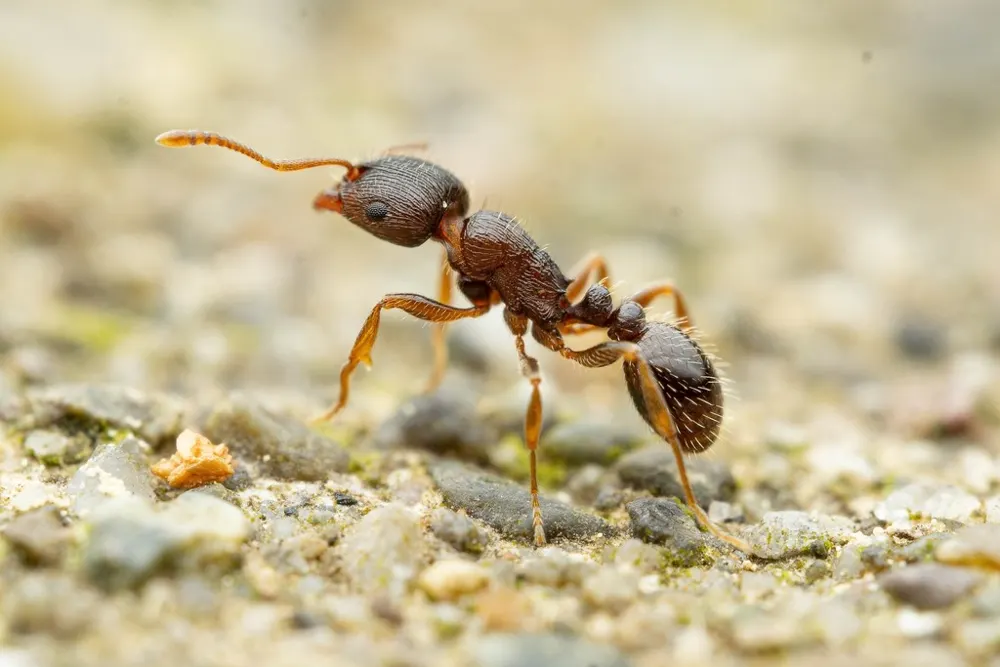
Check these features
- Small dark brown to blackish ant, often with lighter legs and antennae
- Fine parallel grooves on the head and thorax, visible with a magnifier
- A pair of tiny spines on the back of the thorax
- Two bumps (nodes) in the waist
- Little piles of sand or soil along sidewalk cracks, slab cracks or the top of basement walls
Bites and stings
Rarely stings people. A sting, if it happens, is a minor prick that fades quickly; wash the spot with soap and water.
What to do
- Wipe up the ant trail and the food it leads to with a soapy sponge or cloth.
- Store food in sealed containers and clean up crumbs, grease and pet food.
- Place bait stations where ants are active, keep them filled, and follow the label; it can take two weeks or more.
- Look for sand piles at slab and foundation cracks to find where they enter, and seal those cracks.
- If ants keep returning, ask a licensed pro about treating the nest outside.
Look-alikes
Why it came inside
Colonies live under sidewalks, driveways, patios and house slabs, and workers come up through cracks in the slab or foundation to collect sweets, grease, crumbs and pet food. In heated buildings winged ants can come out of the slab in any season.
Keep it out
- Seal cracks in foundations, slabs and around doors with caulk or sealant.
- Keep floors and counters free of crumbs and grease, and do not leave pet food out.
- Keep vegetation trimmed back from the house.
- Keep garbage in lidded containers.
What helps
Links go to Amazon search results so you can compare current options. As an Amazon Associate I earn from qualifying purchases. Always follow the product label.
Enclosed baits work slowly as insects carry the bait back to where they hide. Don't spray near the baits, and follow the label.
See options on AmazonSilicone or siliconized acrylic caulk closes cracks around windows, pipes and baseboards. Bigger gaps need foam backer rod or expanding foam first.
See options on AmazonGlass or thick plastic containers with tight lids keep pantry pests out of flour, cereal, rice and pet food.
See options on AmazonCloses the gap under an exterior door. If you can see daylight under the door, bugs can get in.
See options on AmazonA 10x magnifier makes small features easier to check, like eye patterns, markings or the shield on a tick.
See options on AmazonSources
- University of Florida IFAS (EDIS Featured Creatures)
- Washington State University Pestsense
- Maine DACF (reprint of Penn State Extension fact sheet)
Checked October 18, 2026. Rating backed by 2 sources. How we rate danger.