
Northern black widow
A bite from an adult female can cause spreading pain and muscle cramps like other black widows, so get medical advice right away if you think you were bitten.
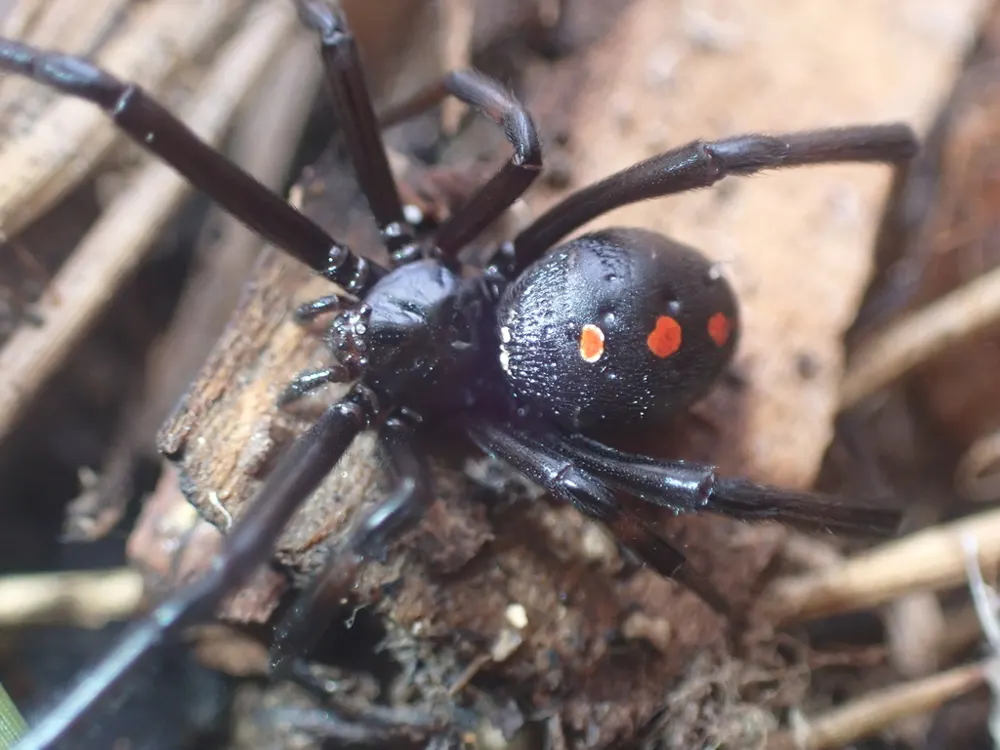
Check these features
- Adult female is glossy black with a round abdomen
- Red hourglass on the underside is split into two separate marks (a broken hourglass)
- Row of red spots down the top of the abdomen, often edged with white or yellow lines
- Tangled, strong web low down in a sheltered spot such as a stump, stone wall or woodpile
- Pear-shaped white egg sac that turns gray and papery with age
Bites and stings
The bite may be felt as a sharp prick or not at all. Pain can then build over several hours and spread, with muscle cramps, a stiff belly, sweating, nausea, headache or raised blood pressure; it may last a day or more. Get medical advice right away for any suspected bite; children, older adults, pregnant people and anyone with heart or breathing problems should be seen promptly.
What to do
- Move away from the spider, then wash the bite with soap and water and apply a cool, damp cloth or wrapped ice.
- Call Poison Help at 1-800-222-1222 (US, free, any hour) for advice on what to do next.
- Call 911 for trouble breathing, swelling of the face or throat, or severe symptoms such as spreading pain, chest tightness or strong muscle cramps.
- If it is safe, photograph the spider or trap it in a jar for identification; do not handle it bare-handed.
- Do not cut the bite or try to remove venom.
Look-alikes
Why it came inside
It mainly lives outdoors in woods, stone walls, stumps and woodpiles, and sometimes ends up in sheds, garages, crawl spaces, greenhouses or basements that are dark and seldom disturbed.
Keep it out
- Wear gloves when working in woodpiles, stone walls, sheds, greenhouses or long-stored boxes.
- Look before reaching into dark, undisturbed spaces.
- Shake out gloves, shoes and clothing kept in garages or outbuildings.
- Seal gaps around doors, sills and foundations and keep firewood away from the house.
- Vacuum webs and egg sacs and discard the bag outdoors.
What helps
Links go to Amazon search results so you can compare current options. As an Amazon Associate I earn from qualifying purchases. Always follow the product label.
Flat glue traps set along walls and in corners show what is moving through and where. Place them where pets and children can't reach.
See options on AmazonCloses the gap under an exterior door. If you can see daylight under the door, bugs can get in.
See options on AmazonSilicone or siliconized acrylic caulk closes cracks around windows, pipes and baseboards. Bigger gaps need foam backer rod or expanding foam first.
See options on AmazonSeals the gaps around doors and windows that let in drafts and bugs alike.
See options on AmazonLets you remove bugs, webs and egg sacs without touching them. Empty the bag or canister outside right away.
See options on AmazonA long-handled catcher moves a spider or insect outside without you having to touch it.
See options on AmazonScorpions glow under ultraviolet light, which makes them much easier to spot at night.
See options on AmazonSources
- Connecticut Agricultural Experiment Station
- Cornell University NYS IPM Program
- University of Minnesota Extension
- Iowa State University Extension (via State of Iowa publications)
- University of Arkansas Arthropod Museum
- Clemson Cooperative Extension (HGIC)
- LSU AgCenter
Checked October 18, 2026. Rating backed by 4 sources. How we rate danger.